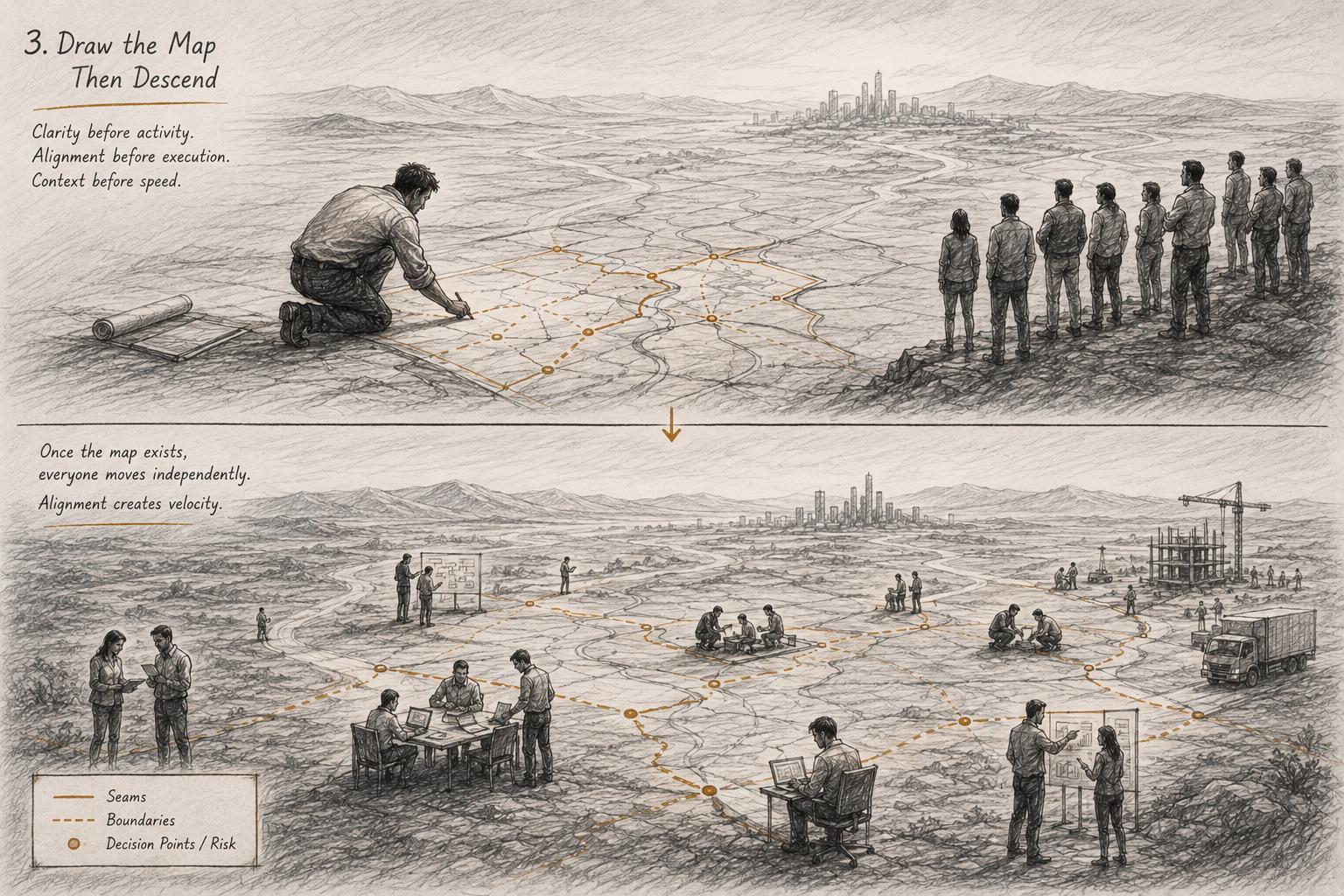
How the business operates across capabilities, processes, concepts, and systems.
The map starts before the request
A request rarely arrives with the full shape of the problem attached to it.
The map here is standing context, built before this request and maintained as a practice as the operating model changes. A new request lands against that context rather than creating the map from scratch. That standing context is what makes the deeper diagnosis in The Request Behind the Request possible before execution narrows the problem.
The form depends on where you are standing. Inside an enterprise, it may arrive as a stakeholder need — change a process, add a capability, connect two systems — already framed in the language of the current operating model. In consulting, it may arrive as a brief, an RFP, a problem statement, or an engagement scope — often already compressed into a proposed solution or a procurement-shaped boundary.
Different packaging. Same structural problem.
In both cases, the request has already been shaped by somebody's vantage. An internal team frames it from the part of the business it owns. A client brief frames it from how the problem has been understood and bounded before you arrived. The people closest to that surface usually understand their part well. A billing team knows billing. A product team knows its product. An engineering team can decompose its own system.
That is not the problem.
The problem is everything the request touches outside the boundary in which it was framed.
This is why I draw maps.
Not because I need a diagram in front of me to think. When an architect has standing context, much of the map already exists as a mental model: how the business operates end to end, which capabilities depend on one another, where processes hand off, which concepts cross domains, and which systems carry those responsibilities.
A concept here is the business meaning underneath a field or entity — shared across capabilities, distinct from the schema that stores it.
The diagram is the externalization of that understanding.
What gets externalized is a working model, not a declaration of truth; making it visible is what makes its assumptions available to challenge.
I draw it so people who each hold a different part of the business can reason against the same shape. Product can locate itself. Engineering can see the seams. Business leaders can see where an operating assumption crosses organizational boundaries. Teams can challenge the model before they independently turn their part of it into a backlog.
Leading change across boundaries depends on shared context. The map gives each team the same view of what is changing, what sits outside its local boundary, and which seams must remain intact. It also makes an architectural claim checkable rather than positional: when a boundary or sequencing decision is contested, the disagreement moves onto a shared artifact that anyone can inspect and argue with instead of resting on competing opinions.
The map is not where the understanding comes from. It is how the understanding becomes shared.
That distinction matters. Two people can look at the same capability diagram and see very different things. One sees boxes and arrows. The other sees where a boundary is under strain, which downstream process depends on an assumption that is about to change, and why a request that arrived in one system is actually moving the shape of the business.
The depth behind that seeing is built through experience, but it does not require years inside the same domain. I wrote about that transferable capability in Ascend Before You Descend: enough depth to learn fast, and enough abstraction to keep moving while you learn. The drawing comes later.
When you have days, not years
But you do not always have years to build it.
Sometimes you have days: a proposal under a tight timeframe, an unfamiliar domain, and a narrow request that says very little about the unknowns around it. The same skill still applies. You abstract what you do not yet understand into black boxes, compare the shape against businesses and systems you already know, infer enough of the capability structure to reason about the problem, and make the assumptions visible.
That does not make domain expertise irrelevant. It changes when you need it. You do not need to understand every black box before you can see how the boxes may relate. You need enough technical and architectural depth to know what can safely remain abstract, what must be learned quickly, and which unknowns are load-bearing enough to validate before you commit.
The fast mode exposes something that is true in the standing mode too: the map is always partly assumption. Years of context reduce the unknowns; they do not eliminate them.
The skill is not knowing everything. It is building a working model with known gaps — and knowing which gaps can stay black boxes and which ones can change the shape of the decision.
And having that model — whether it took years or days — changes the relationship between diagnosis and execution.
In The Request Behind the Request, I wrote about recognizing when the stated request is only the visible edge of a deeper problem. That recognition is possible because there is already a broader operating model to compare the request against. Then the same map becomes the surface on which the target state is made explicit and execution is coordinated.
So the map is not a step that begins after diagnosis.
It is standing context — built before the request, refined by the request, and redrawn so everyone can move toward the same target state.
Not a delivery conversation yet
When a business problem first reaches architecture, I am not thinking about delivery.
Not yet.
The first question is not how many teams it will take, how long it will run, or what the implementation will cost. Those are useful questions later. At this stage they pull the conversation into the wrong lens.
The first job is to understand the objective.
What is the business actually trying to change? What constraint are they running into? What outcome would make the problem disappear? And once that objective is understood, what is the real scope of the change across the business?
That conversation can expand the problem, but just as often it reduces it.
A request is frequently shaped by the local process people already know. They ask for a larger workflow change, another system behavior, or a new layer of automation because they are working around a constraint inside their own boundary. Once the objective is separated from that local solution, the actual change may be simpler than the request that arrived.
That is not architecture making the work smaller for its own sake. It is removing work that exists only because the problem was framed from one part of the operating model.
Only after the objective, impact, and meaningful boundaries are understood does the delivery conversation begin.
Then scope can be set. Prioritization and criticality can turn the target state into a roadmap. Some capabilities may need to move now and others later. A tactical path may be the right first step. In other cases, the organization may deliberately accept bounded technical debt and live with it for a period because the strategic move is not yet worth the cost.
Those are conscious roadmap choices.
The number belongs there — after we understand what we are actually choosing to change.
Start with how the business operates
A capability map drawn only for the current project is useful, but it is not the same thing as capability architecture.
The stronger asset is a working end-to-end model of the domain or enterprise: what the business must be able to do, how those capabilities connect through processes, where information and decisions move, and which systems currently implement them.
In a brownfield environment, much of this work is reverse engineering. The architecture may never have been written down cleanly. The real operating model is distributed across systems, process documents, organizational habits, data structures, and the people who have learned where the exceptions live.
The map does not need to be one giant enterprise poster. It can be a connected set of views. What matters is that you can follow the business across domain boundaries rather than stopping where one application or organization stops.
When a new requirement arrives, place it against that current-state model.
Then ask what moves.
A direct capability may change. That change may alter a handoff. The handoff may affect a downstream capability that nobody included in the initial scope. A system that looked unrelated may be consuming a concept whose meaning has changed.
Only after that impact is understood should the target capability shape become the new reference.
In greenfield work, the same principle applies without the reverse engineering: build a working model of the capabilities, processes, concepts, and boundaries that need to exist before allowing the application architecture to define them accidentally.
This is the difference between designing from the business outward and decomposing from the system inward.
A smaller example shows why this matters in ordinary work.
Suppose a sales-enablement team asks to change how leads are assigned. The request is legitimate and may look contained inside lead management. But someone holding the broader operating model will immediately ask what else depends on that assignment: quota or coverage, compensation or credit, lead-quality measurement, conversion attribution, historical reporting.
The architect does not need to know every answer.
The job is to recognize that the request crosses business-process boundaries and that some of the people who own those processes may not be in the conversation yet.
The map tells you not only what changes. It tells you who is missing from the room.
That is easy to miss when everyone is organized vertically. Business optimizes the process it owns. Product often optimizes a bounded product surface. Engineering optimizes the systems implementing that surface. Every local decision can be reasonable while the end-to-end result still drifts.
This is often how conceptual debt begins: local optimization leaves out cross-domain context, the local implementation becomes shared meaning, and adjacent teams discover the missing concepts later through exceptions and patches.
The map catches that failure earlier by making capabilities, processes, ownership, systems, and handoffs visible together.
Make the concepts and boundaries explicit
Once the impact is understood and the target state is taking shape, name the concepts that cross the affected capabilities.
This is execution work, not another round of diagnosis. The goal is no longer to discover whether two meanings are different. That decision has already been made. The goal is to ensure every team builds from the same meaning.
If two concepts must remain separate, write that separation into the shared model. If one domain owns a rule and another presents the user experience, make that visible. If history must be preserved as a changing relationship rather than overwritten as current state, show it before someone chooses a schema that cannot represent it.
The map should answer questions such as:
- What concept is this team implementing?
- Which domain owns the decision?
- Which other capabilities consume the result?
- What information is authoritative?
- What can vary internally without changing the rest of the system?
You are trying to remove accidental interpretation from the seams.
That is especially important when several teams are working in parallel. Inside a team, ambiguity can often be resolved through conversation. Across domain boundaries, ambiguity becomes architecture.
Design the boundary, then make the seam explicit
Once the target capabilities and ownership are clear, decide where change should be contained.
At this altitude, a boundary does not have to be a software service. It might surround a business process, a capability, an operating responsibility, an application, a platform, or a technology choice.
The question is the same:
What should the rest of the enterprise be allowed not to know?
Outside
Inputs · obligations
What the boundary must accept or honor
Black box
Capability / domain responsibility
Internals can evolve without becoming everyone else's dependency.
Outside
Outputs · allowed dependencies
What the rest of the enterprise may safely assume
Treat the inside as a black box first. Define what responsibility belongs there, what enters, what leaves, who owns the meaning, and what other parts of the business are allowed to depend on.
You do not need to resolve every implementation choice to do that well.
A capability may eventually be implemented through a new application, an extension of an existing platform, a manual process, or some combination. Early in the architecture, those internals may still be ambiguous. That is acceptable if the boundary around the responsibility is clear enough that other teams do not have to depend on how the inside works.
Then the internals can evolve.
A process can change. A tool can be replaced. A platform can be modernized. An implementation can be rewritten. If the boundary was designed well, most of that change remains contained.
This is why the size of the boundary matters.
Too small, and internal decisions leak outward through dozens of dependencies. Too large, and unrelated responsibilities become coupled inside the same box. The architectural work is finding a boundary that contains meaningful change without hiding responsibilities that actually need to remain independent.
A well-designed boundary turns future change into an internal problem instead of an enterprise problem.
At lower levels, the same principle becomes more concrete. The seam may show up as an API contract, an event, a state transition, a data ownership rule, or an integration handoff. Those mechanisms matter, but they are expressions of the deeper architectural decision: where the black box begins and ends, and what the rest of the enterprise is allowed to assume about it.
Good seams localize change.
Ownership has to be executable
“Team A owns this” is not enough.
Ownership has to be visible in the decisions the map assigns.
- Who decides the business rule?
- Who persists the authoritative state?
- Who publishes it?
- Who is allowed to interpret it?
- Who handles failure?
- Who changes the contract when the capability evolves?
Those questions matter because systems often become coupled through unowned decisions rather than through obvious technical dependencies.
If two domains can both change the meaning of the same concept, the map is not finished.
If one domain owns the data but another owns the rule that gives the data meaning, that relationship needs to be explicit.
If everyone consumes an answer but nobody owns producing the truth behind it, the implementation will eventually invent an owner.
The map should prevent that invention.
What this looks like in practice
Consider a platform whose operating model was built around one-time purchases. The business now wants to add subscriptions.
A team working inside billing can decompose the obvious work well: recurring charges, invoice cadence, payment retries, perhaps a new subscription object in the billing platform. None of that requires an enterprise architect to tell the billing team how billing works.
The architectural question is what the change does outside billing.
Against an end-to-end operating map, the shift from purchase to subscription changes more than a payment pattern. The customer relationship now persists through time. Entitlement has a lifecycle. Provisioning may need to respond to renewal, suspension, and reactivation. Service teams need to understand states that did not exist before. Reporting that assumed a completed purchase was a completed commercial event may now be wrong. A downstream partner or fulfillment capability may consume a status whose meaning has quietly changed.
Change in commercial relationship
One-time purchase → subscription
Entitlementlifecycle
Provisioningrenew · suspend · reactivate
Servicenew states to understand
Reportingcommercial-event assumptions
Partner / fulfillmentstatus meaning
Some of those capabilities may not appear anywhere in the original subscription project.
That is the value of the standing map. It reveals the handoffs and consumers outside the stated scope before they become production surprises.
Now imagine the same large request approached without that cross-domain model.
A capable delivery team can still produce a strong technical implementation. It can migrate the current process to a newer platform, add recurring billing, integrate the systems it was asked to integrate, and deliver the scope it was given.
And the organization can still arrive at the end with newer technology and many of the same business constraints.
The difference is not that one team had a better diagram. Both could have diagrams — possibly very similar ones.
The difference is what they can see in them.
One view stops at the system boundary and asks how to implement the request. The other holds enough of the operating model to see that the request changes boundaries across the customer lifecycle and therefore changes assumptions in capabilities that were never named in the initial scope.
That is the difference between decomposing a large order and shaping a transformation.
Without the broader map, you can be an order-taker at enormous scale. A multi-year program does not become transformational simply because it is large.
Once the target shape is agreed, the diagram becomes important for a different reason: alignment. The architect may already hold the model mentally, but six domain teams do not hold the same six pieces. The map gives them one shared surface on which to see the affected capabilities, the changed boundaries, the upstream and downstream touchpoints, and the seams they now have to build together.
Then they can descend.
Risk has shape
Once capabilities, concepts, ownership, and seams are visible, risk becomes easier to locate.
Risk is not the same as size.
A large implementation inside a well-contained domain may be safer than a small change to a shared contract. Ten lines in a money path can carry more risk than thousands of lines of isolated transformation code. A minor schema decision can have a larger blast radius than a substantial user-interface rebuild.
The map lets you ask where failure travels.
Look at:
- criticality
- blast radius
- reversibility
- coupling
- data integrity
- security and access
- money or entitlement paths
- operational recovery
- number of downstream consumers
This changes how review effort is allocated.
High-volume work does not automatically deserve the deepest architectural attention. High-consequence seams do.
That distinction becomes even more important as AI accelerates implementation. Faster code generation does not reduce the blast radius of the wrong contract.
Place tactical bridges deliberately
Sometimes the target shape is clear and the immediate delivery cannot wait for all of it.
A tactical bridge may be the right execution choice.
But once the target architecture is visible on the map, the bridge should also be visible on the map. Do not let it disappear inside a backlog as if it were simply another implementation detail.
A useful tactical bridge should be:
- bounded to the immediate need
- reversible where practical
- isolated from the target model so it does not redefine it
- recorded explicitly as debt
- owned by someone
- paired with an exit trigger that says when the bridge should be removed or replaced
This matters because bridges attract traffic.
The next team sees something that already works and extends it. The temporary path gets another dependency, then another. Eventually the migration away from it becomes harder than the original strategic implementation would have been.
The map should distinguish the bridge from the destination while both are still visible.
Descend in order
Once the shared shape is stable enough, descend.
The exact sequence varies, but the movement should be deliberate:
01Business outcome
02Current-state capabilities and process
03Impact and target capabilities
04Business concepts
05Domain ownership and boundaries
06Information and process changes
07Application interactions
08Integration contracts and events
09Detailed design
10Code
This is not a waterfall.
Teams can move in parallel. Discovery can continue. Detailed work can expose assumptions that need correction. The point is not to finish every layer before touching the next one.
The point is to avoid making a lower-level decision responsible for defining a higher-level truth.
A database schema should not accidentally decide the business concept. An API should not invent ownership. A workflow should not become the first place the operating model is made explicit.
The descent gives each decision an altitude where it belongs.
When the implementation disproves the map
The map will be wrong somewhere.
That is normal.
Detailed implementation exposes facts that architecture could not know from above: latency constraints, platform behavior, edge cases, operational recovery paths, data quality, legacy coupling, and technical limits that only become real once someone opens the box.
The mistake is not discovering that the map was wrong.
The mistake is fixing a map-level error only at the implementation level.
If detailed design reveals that two concepts cannot be separated the way the map assumed, return to the concept level. If an integration contract exposes unclear ownership, return to the domain boundary. If a platform limitation changes the viable capability path, revisit the architecture rather than accumulating compensating logic underneath it.
Ascend to the level where the assumption failed, correct the frame, then descend again.
I have found this psychologically harder than it sounds. Teams already have momentum. Work has started. A local patch feels cheaper than reopening something “already decided.”
Sometimes it is cheaper.
Sometimes it is merely the first payment on a debt that will be charged to every downstream team.
The map is not a contract against learning. It is the place where learning gets reconciled.
What the map buys you
The payoff is not the diagram.
The payoff is shared context.
The architect may already understand the end-to-end shape. But transformation cannot depend on everyone else reconstructing that understanding independently.
Externalizing the model lets business, product, engineering, and delivery challenge the same assumptions, see the same changed boundaries, and locate their work against the same target state.
From there, the payoff becomes coordinated autonomy.
Teams know what they own, what they can change independently, what contract they must preserve, and where they need to come back together. One team can change its internal implementation without destabilizing another. Multiple teams can build in parallel because the seams between them are already understood.
The map lets the work decentralize without the architecture fragmenting.
The question of who holds the whole shape, makes the judgments, and helps set the transformation boundary sits at a different level; I cover that responsibility separately in The Transformation Architect’s Vantage. Here, the map makes that understanding inspectable and usable by everyone who has to execute against it.
Do not map what does not need a map
There is an opposite failure mode.
Architecture can become ceremony.
That skepticism is earned when enterprise architecture becomes a repository of diagrams nobody opens. A standing map earns its place by staying connected to live decisions and changing as the operating model changes. When the context stops moving with the business, the diagram has become inventory.
A small, well-understood, reversible change with clear ownership and no meaningful effect outside its boundary does not need a full capability impact exercise, domain workshop, contract review, and ten-layer descent.
Sometimes the correct architecture process is to build the thing.
Use the map when the cost of independent interpretation is meaningful: cross-domain decisions, shared concepts, unclear ownership, significant blast radius, or work whose consequences extend beyond the team or system where the request originated.
Skip the ceremony when the decision is genuinely local and the consequences are contained.
The goal is not to maximize architectural artifacts.
It is to make enough of the operating shape visible that the right people understand what is changing before execution fragments it.
Draw the map, then descend
The map usually starts before the project does.
It starts as accumulated understanding: how the business operates, where capabilities meet, what the systems actually do, and where the constraints have hardened over time.
A new request lands against that model.
Sometimes it fits cleanly.
Sometimes it lights up parts of the business nobody thought were in scope.
That is the moment to resist turning the request directly into a task list.
On your next non-trivial request, notice what the implementation is about to decide that belongs higher on the map.
Understand the impact. Redraw the target state. Make the changed capabilities, concepts, ownership, seams, risks, and bridges visible to the people who have to move together.
Then let the teams descend.
And when the details prove the map wrong, climb back to the level where the mistake entered and redraw it.
The drawing is not the understanding.
It is how the understanding becomes shared — so a transformation does not become a collection of locally correct implementations moving in different directions.