How an IC Architect Runs an Enterprise Transformation
Six levers I used to lead a client-centric GTM transformation as an individual contributor — and why architectural authority can be more durable than title authority.
Most transformation writing is a retrospective dressed as a framework: here is what we did, rendered calm and inevitable after the fact. This is not that. These six levers are the actual mechanics of how an individual contributor runs an enterprise transformation when the people who would normally own it — product, program, delivery leadership — either can't move fast enough or won't take the risk.
I ran a program called Skytree this way: a client-centric GTM transformation that restarted a failed $5M reimplementation and shifted the company off an operational-centric commercial architecture. The detailed account is in the companion case study. This piece is about the method.
One framing note before the levers. "Without formal authority" is the obvious way to describe IC-led transformation, and it's the wrong one. It positions you as an underdog who got lucky. The truer thing is that there is a different kind of authority — architectural authority, earned through diagnostic capability and delivery — and on a transformation it turns out to be more durable than the kind that comes with a title. The levers below are how you build and spend that authority.
1. Reverse-engineer the truth from the data
This is the load-bearing lever. On any transformation, the gap between what a system actually does and what people believe it does is enormous. Most senior people respond to that gap by escalating, convening, or hiring discovery. The faster path is to read the system backward — reconstruct the real process from its data lineage, including the parts the business has forgotten and the parts engineering never knew.
On Skytree, the agency data had no owner and the business wanted to skip it. I built mastering logic across five sources and cleaned millions of records in two weeks, because that was the only way to know what was true before go-live. The capability isn't speed. It's that the data is the one stakeholder that can't spin you.
The lever: find the truth yourself, from the evidence, before you let anyone tell you what the truth is.
2. Lead with context, not control
Without a title, you can't direct anyone. Good. Direction is the weaker instrument anyway. What moves a room of senior people is a clearer picture of reality than anyone else in the room has — the diagnosis, the architecture, the consequence of inaction, all crisp.
Every senior conversation on Skytree started at a disadvantage; some of the people in them were hoping I'd fail. I didn't win those rooms by claiming authority I didn't have. I won them by being the person who understood the problem most precisely, and by showing it fast.
The lever: earn the right to be followed by being the clearest, not the most senior.
3. De-risk by phasing, not by waiting
The instinct under pressure is caution. On a transformation, caution is its own risk — slow programs lose the political window that funded them. The move is to make big bets, but structure them so failure stays small and recoverable.
I chose against a big-bang rollout. I phased it, and I deliberately started Phase 2 before Phase 1 closed so the phases de-risked each other instead of stacking risk end to end. That confidence isn't bravado. It comes from having seen enough failure modes that you can spot them in the design before they show up in production.
The lever: sequence the work so that being wrong is survivable, then move at the speed the window allows.
4. Translate across altitudes
A transformation lives or dies on whether the same idea survives the trip from the senior leadership team down to a developer. Most people can operate at one altitude. The IC architect who can hold the strategy, the architecture, and the implementation in one head — and speak each one to the audience that owns it — becomes the connective tissue the program otherwise lacks.
On Skytree I built the slides whose only job was to move leaders from an operational frame to a client-centric one, met each leader individually to tailor the case to their org, and presented to the SLT directly — then turned around and specified the same model for the engineers building it.
The lever: be the one piece of the org that speaks every layer's language, and the layers will route through you.
5. Own the gap nobody will own
Every transformation has a gap that belongs to no one — the work that's too ambiguous, too cross-functional, or too risky for any single owner to claim. Most people manage that gap by escalating it. Sometimes there's no one to escalate to.
Phase 2 migration had stalled at six months across ten teams. Morale was gone, the conflict had turned personal, and multiple directors and a VP had visibility but wouldn't own the recovery. I volunteered for two weeks with a rearchitected strategy. Within a week the original lead was reassigned, and we went live on the original date with no disruption. I didn't step in because it was mine. I stepped in because the inaction risk was higher than the risk of acting, and I could see the architecture clearly enough to fix it under pressure.
The lever: when the gap is unownable and you can actually close it, close it — that's where IC authority is minted.
6. Drive outcomes, not activity
The last lever is the discipline that holds the other five together. Run the planning, the risk mitigation, the team mobilization, and the delivery reviews against business impact, not against motion. Cut scope and reorder priorities to balance speed and risk. Program velocity doesn't come from pressure. It comes from precision — knowing what matters most this week and staying on it.
The lever: measure the program by what moves, not by how busy it looks.
The flywheel
These aren't a checklist; they compound. Diagnostic truth (1) earns you context-based authority (2). That authority lets you make confident phased bets (3). Operating across altitudes (4) lets you spend the authority where it matters. Owning the unownable gap (5) converts trust earned in conversation into trust earned in delivery. And outcome discipline (6) protects all of it from drifting into activity — which feeds back into the next diagnosis, sharper than the last.
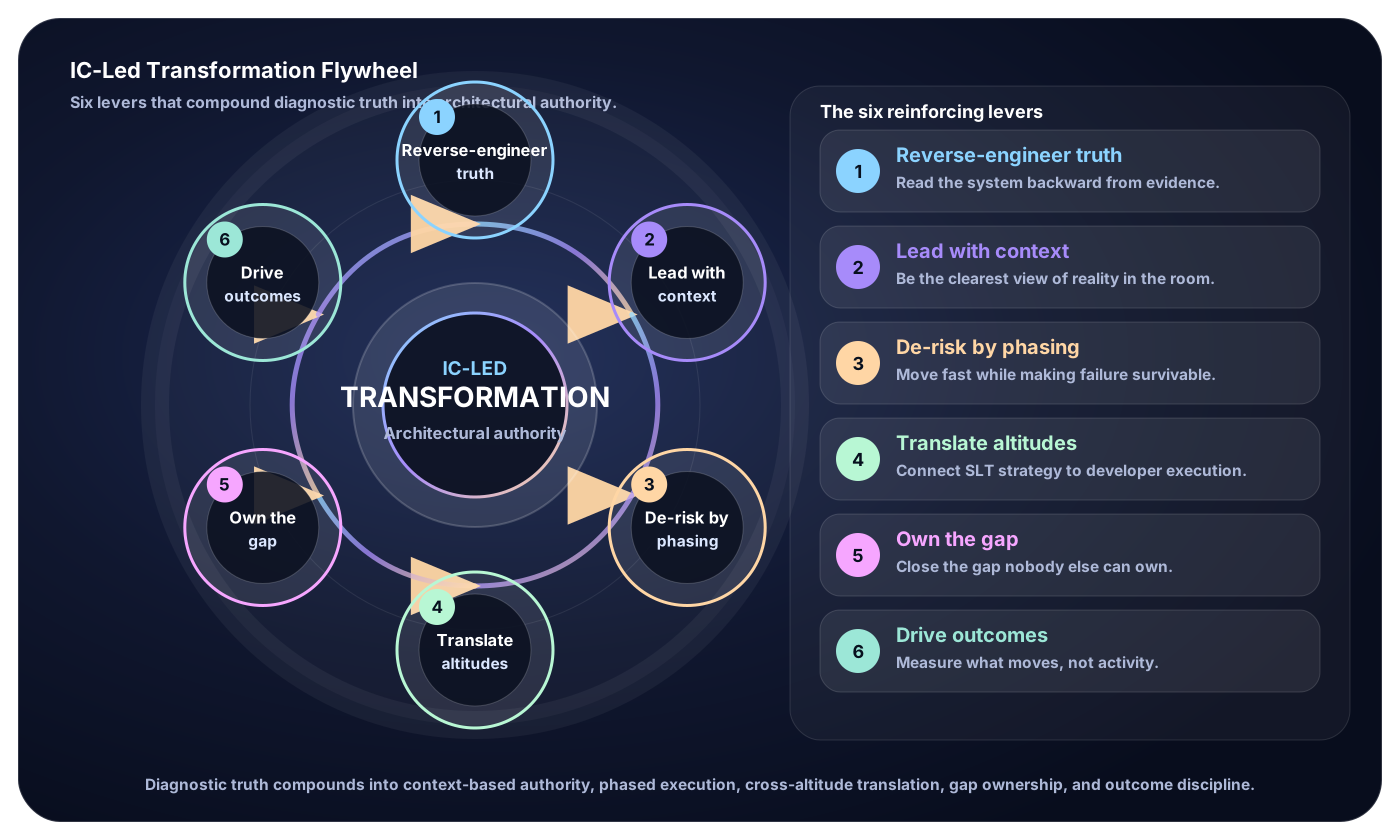
The six levers compound: diagnostic truth earns context-based authority; authority enables phased risk-taking; cross-altitude translation and gap ownership convert trust into delivery; outcome discipline sharpens the next diagnosis.
A closing note
I led Skytree without a title that gave me power, and for a long time I described it that way — as leading "without authority." I've stopped. The authority was real; it just wasn't issued by an org chart. It was issued by the data I could read, the rooms I could move, and the dates I hit. That kind of authority is rarer than the titled kind, harder to take away, and — if you're the kind of person who comes alive inside ambiguous, high-ownership problems — far more worth building.
Companion case study: Skytree — Restarting a Failed $5M Transformation as an IC Architect.
Reader Takeaway
The lesson is not that every transformation should be IC-led. The lesson is that some transformations stall because formal ownership and actual problem ownership have separated.
When that happens, authority has to be rebuilt from evidence: diagnostic truth, cross-altitude translation, phased risk, delivery credibility, and the willingness to own the gap nobody else can close.
That is not informal leadership as a slogan. It is architectural authority in practice.