The AI Architect’s Governance Playbook
Six levers for turning AI speed into durable execution instead of invisible debt. Most AI-native advice is about prompts, tools, and speed. This is about the thing that makes the speed survive contact with a real system: governance — not governance as bureaucracy, but governance as architecture. The case for why AI needs an arbiter is in the companion piece, Governed Autonomy. This is the method behind it — the actual mechanics I used to build an AI-native product while working full time, in 40 days, without letting the AI quietly redefine the system underneath me. Six levers. Each one is a place where I learned, usually the hard way, that intent does not survive the default behavior of an AI coding tool unless something outside the model holds the line. One note before the levers. Governance here is not a process you run after the work; it is the structure the work happens inside. Done well, it doesn't slow the build down — it's the only reason the build stays buildable.
1. Draw the map before you build
AI makes it dangerously easy to start building before the problem has a shape. A model handed an under-framed problem will fill the gap with plausible structure you did not choose.
The first move is to define the capability map: what the system must do, where the boundaries sit, and which seams must hold before any implementation begins. That map becomes the surface the AI works against.
The full method is captured in Draw the Map, Then Descend. This lever is that method applied to AI-native product building: do not let the model frame the problem, invent the seams, or turn your unstated assumptions into code.
The lever: draw the capability map first, agree the seams, then let AI accelerate inside the frame.
2. Make architecture the arbiter
An AI can reason fluently about your system without owning a single long-term consequence of being wrong. That's the whole risk. The fix isn't to remove the AI from the loop — it's to stop letting the AI be the arbiter of the system. Something outside the model has to decide what's allowed, what's out of bounds, and what must stay stable under pressure. That something is architecture — but only once it stops being a diagram and becomes a contract. A contract makes disagreement checkable. Does this respect the boundary? Does it preserve the intent? Does it grow or shrink the blast radius? Does it create hidden coupling? On my build, every decision of consequence became a recorded architectural decision the AI had to answer to — not a suggestion it could renegotiate mid-task. Intent doesn't survive an AI tool's defaults; the recorded decision is what holds the line when the model reaches for a "reasonable" shortcut. The second half of this lever is knowing what the AI must never own. It can implement, explore, draft, and challenge — inside a constrained judgment surface. But the high-consequence judgments stay governed: system boundaries, risk appetite, irreversible actions, the authority to bypass a control, the interpretation of a core principle. A mature operating model doesn't give the model unlimited authority. It gives it the right surface area and keeps the rest explicitly human. The lever: make architecture a contract the AI answers to, and draw a hard line around the judgments it is never allowed to make.
3. Audit before you dispatch
The fastest-looking path with an AI is to describe the problem and let it start changing code. It's also the most expensive, because the model acts on the first plausible reading of the problem rather than the true one — and you won't see the gap until it ships. So the first response to any non-trivial request is an audit, not a change. State the question being answered. List the code paths actually inspected. Surface what's true today, what's drifted, what's broken. Propose a scope with explicit in-scope and out-of-scope. Then ask for authorization before a line changes. Diagnose from evidence — read the system backward, run the query, confirm what's real — before accepting anyone's narrative of the problem, the model's included. One discipline inside this one: an audit ends in a recommendation, not a menu. "Here are three approaches, you pick" is an audit that refused to do its job. The architect's value is the judgment that picks; handing that back to the operator is abdication dressed as options. The lever: audit first, diagnose from evidence, recommend a path — and only then dispatch the work.
Audit is the control point
4. Forbid silent failure
Left to its defaults, an AI optimizes for things-not-crashing. It will synthesize a "reasonable" fallback when a value is missing, substitute a placeholder to keep the flow alive, quietly no-op when configuration is absent. Each is a small lie the system tells you — and lies compound into a system whose behavior no longer matches anyone's mental model of it. The rule is that the system never hides what it did and never invents what it lacks. A missing value isn't an invitation to guess; it means rejected, or incomplete, or misconfigured — and the system says so. It operates on the configured value or it refuses and surfaces why. NULL means rejected, not use a default. Every fall-through carries a typed reason. An inference is labeled an inference, never presented as a verified fact. This isn't pedantry — you can't govern a system that quietly papers over its own gaps, because you can't see them. The most dangerous version is the helpful fallback: "I added a default so it wouldn't crash." That's not a fix; it's a mask over the real defect, and it's exactly the kind of move an AI makes by reflex. Catch it every time. The lever: no silent defaults, no silent drops, no invented data — make the system declare what it did and refuse what it can't honor.
5. Stay subtractive and atomic
AI generates code faster than any team cleans it, and that asymmetry is fatal if left unchecked: the system accretes logic faster than anyone can keep it coherent, and every added line is a future line to refactor. So the default bias inverts. When the choice is between adding new logic and removing wrongly-applied existing logic, prefer the removal. A change that nets negative lines is usually the correctly-scoped one. When you do fix something, fix the whole thing. A real fix touches every site the broken feature drifted to, in one atomic unit — not "patch the crash, file four follow-up tickets." The audit that finds all the drift sites is part of the fix, not a separate phase. And the discipline that keeps this from sprawling is forward-only: the patterns govern new and changed code; you don't refactor the surrounding working code while you're in there. Drift outside the scope gets named in a "noticed but not touched" section and left for a deliberate decision later. That gives you visibility into debt without turning every fix into an unbounded refactor — and it stops the AI from "improving" things it was never asked to touch. The lever: remove before you add, fix the whole feature in one atomic unit, and never let the AI refactor outside its mandate.
6. Govern the collaboration, not just the code
The failure mode nobody warns you about isn't in the code — it's in the working relationship with the model. Over a long build, the collaboration itself drifts: the model gets defensive, debates go in circles, trust erodes, and you end up arbitrating every disagreement from memory and exhaustion. That relational drift is as real as technical drift, and it breaks programs the same way. You govern it with structure, not willpower. Separate the roles explicitly and hold the line: human intent and final authority on one side, architectural governance in the middle, AI acceleration inside the boundaries — never collapsed into one. Make the doctrine a thing the model re-reads at the start of every session, because intent doesn't carry across context windows on its own. Treat session handoffs as structural, not optional: the cost of a missing current-state artifact is hours of re-explanation, every time. The model has no memory of yesterday's hard-won decision unless you give it one. This is the lever most people skip, because it feels like overhead on top of the "real" work. It is the real work. The build I shipped didn't survive because the code was clever; it survived because the collaboration had a structure that held when both of us were tired. The lever: govern the partnership like a system — explicit roles, re-stated intent, structural handoffs — because a model with no consequences and no memory won't hold the line for you.
The flywheel
These aren't a checklist; they compound. The map (1) gives you the frame to set boundaries the AI answers to (2). Those boundaries make it possible to audit each action against something real (3). Auditing surfaces the truth, and the no-silent-failure discipline (4) keeps that truth from being papered over. A system that can't hide its gaps is one you can keep subtractive and atomic (5) — you can see all the drift, so you can actually close it. And governing the collaboration (6) keeps the partnership coherent enough to do all of the above when you're tired. Then the wheel turns again. Each governed cycle hardens the architecture — more decisions recorded, more invariants encoded, sharper contracts, cleaner boundaries — so the next cycle moves faster with less risk. That's the part most people miss: governance isn't a tax paid against speed. It's the thing that lets speed compound instead of collapsing into invisible debt. Each turn deposits more governed autonomy at the center than the turn before.
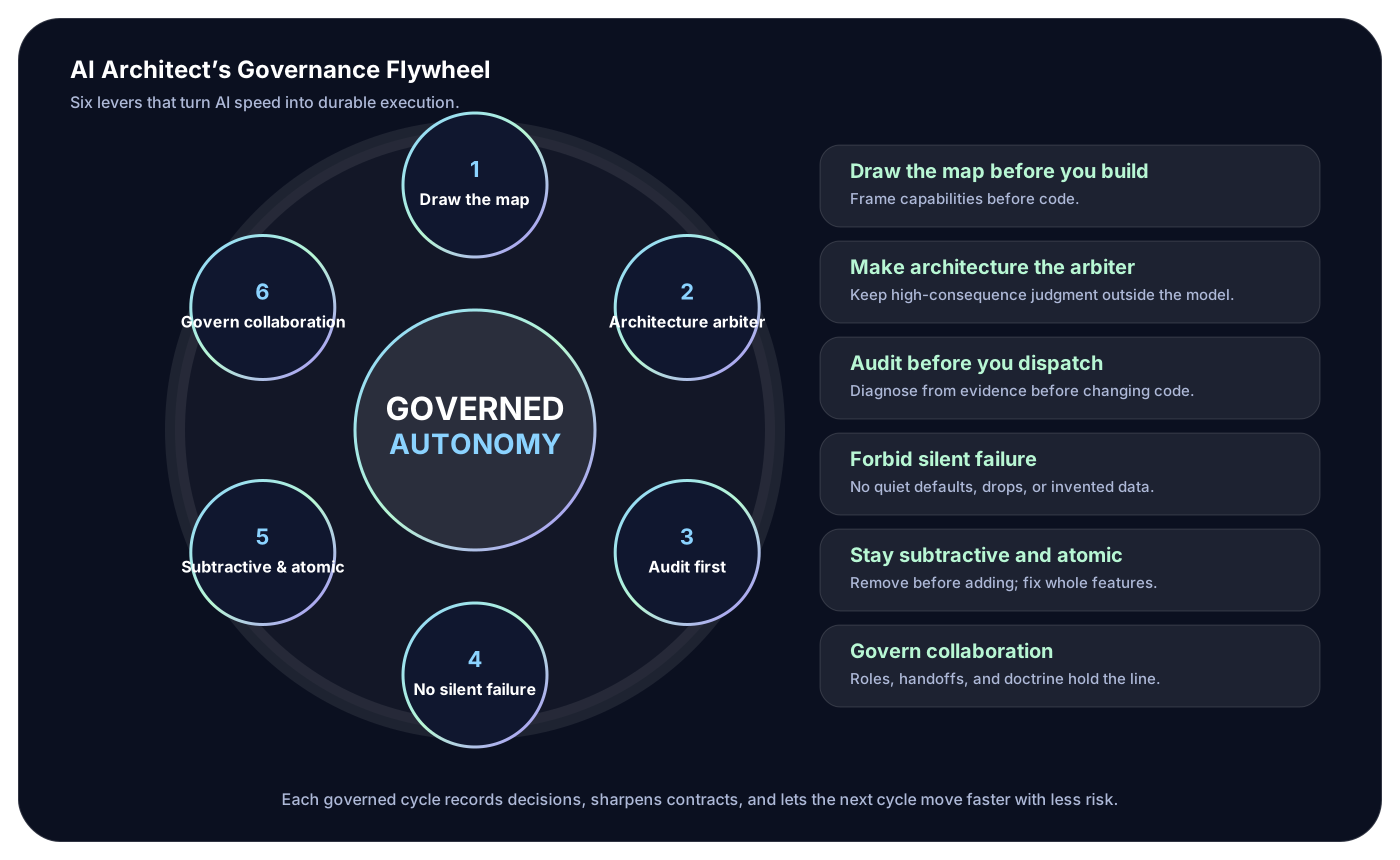
The hub is governed autonomy: each cycle hardens the architecture so the next cycle moves faster with less risk.
A closing note
I learned these levers building a product alone, in compressed time, with an AI as my primary collaborator — and I learned most of them by first doing the opposite and watching the system, and the collaboration, start to come apart. The lesson underneath all six is the one that's governed my work for two decades of enterprise architecture: the discipline that turns speed into durable execution is architecture — not as documentation, but as the thing that decides what's allowed and holds when everything is under pressure. The medium changed. The AI is new; the failure mode is not. A program drifts when no one holds the boundary between what should move fast and what must never move without authorization. With AI, that boundary just moves faster and matters more.
Reader Takeaway
AI doesn't become trustworthy by becoming more capable. It becomes trustworthy when its capability operates inside boundaries something other than the model is responsible for holding. The teams that win the AI-native era won't be the ones that let AI do the most. They'll be the ones that drew the map, made architecture the arbiter, and knew exactly what the model was never allowed to own. That is not governance as bureaucracy. It is architecture as the discipline that turns AI speed into durable execution.