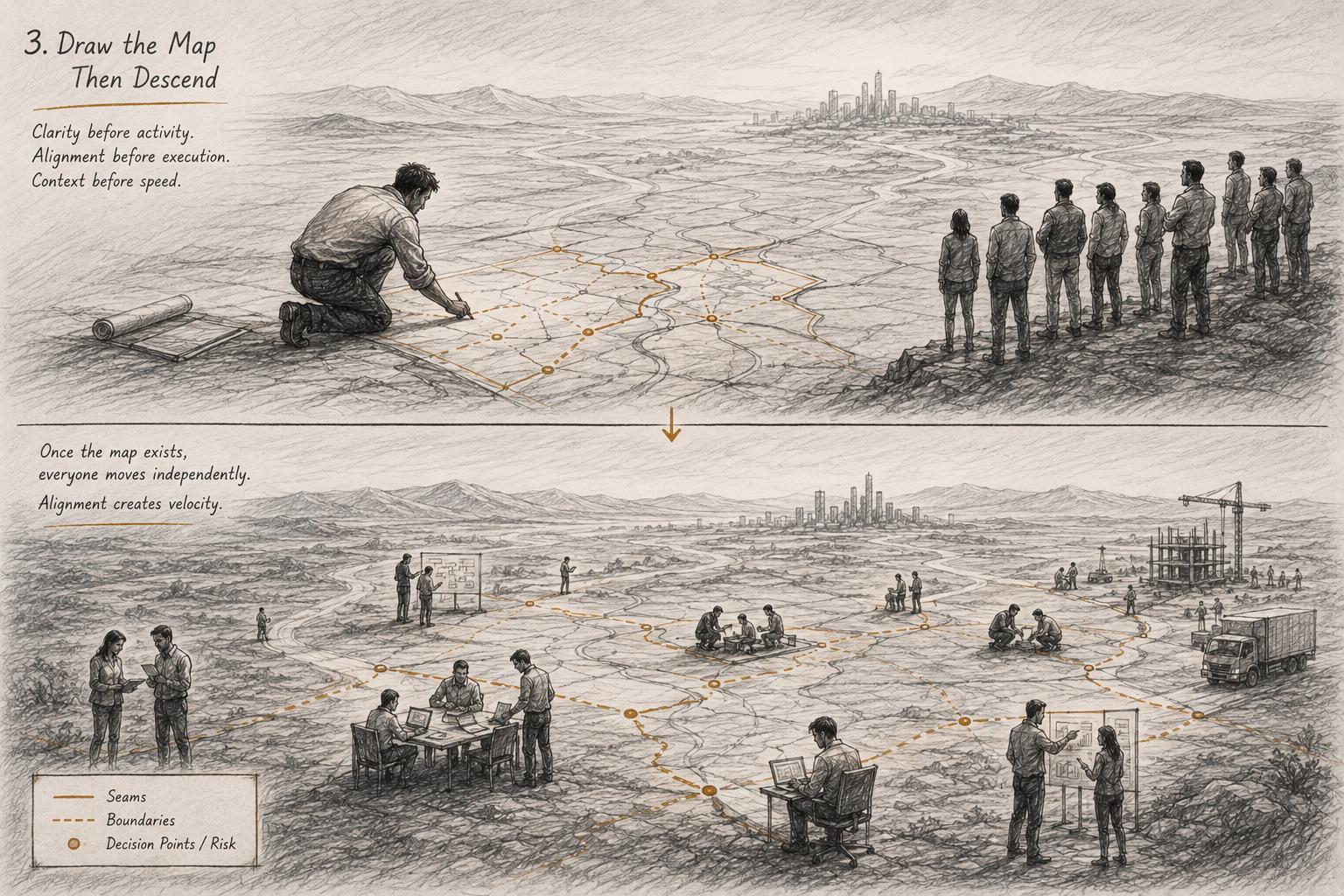
Draw the Map, Then Descend
Why complex work should not begin with the task list, the estimate, or the code.
Draw the map, then descend
Resist the Single Number
Most complex problems are reduced too early.
A team asks for the size, the estimate, the ticket count, the technical stack, or the first implementation step. Those things matter, but none of them can hold the shape of the problem.
A single number gives stakeholders something to approve or reject. It does not give them a shared surface to reason against.
A map does.
A map lets people see the boundaries, seams, risks, dependencies, and missing pieces. It gives the room a way to locate disagreement. It turns ambiguity into something that can be discussed, challenged, and refined.
That is why the first move is not the IDE.
The first move is the map.
Capability Before Implementation
The map is not the diagram. The diagram is only the visible artifact.
The real map is the architect’s perception: the ability to see capabilities, actors, decisions, constraints, data movement, ownership, seams, and blast radius before the system is built.
That perception starts with capabilities: what the system must do.
Capabilities are more stable than implementations. Code changes. Platforms change. Teams change. Names change. But the underlying capabilities — execute a trade, manage risk, align a customer relationship, govern an AI dispatch, reconcile data truth — survive the churn.
Starting with capabilities prevents the architecture from being trapped inside today’s tools.
It also prevents AI from inventing the structure for you.
An AI working against a visible capability map can accelerate inside a frame. An AI working against unstated assumptions will create drift.
Seams High, Internals Low
Once the map exists, decide the seams high.
Settle the boundaries, handoffs, contracts, information flow, and ownership while each domain is still a box on the map.
Then descend.
Open each domain only after the context is clear. Fill in internals after the seams are stable. Repeat the same sequence at every zoom: platform, domain, subsystem, change.
This is how speed becomes safe.
Parallel work becomes possible because the seams are known. Internal rework stays contained because the contracts hold.
Risk Has Shape
Risk is not just size.
A small change to a critical contract can be more dangerous than a large cosmetic change. A large test expansion can be safer than a ten-line mutation in a money path.
That is why inspection should follow risk, not raw volume. Architecture turns risk from instinct into a structured conversation.
The Descent
The descent begins only after the frame is clear.
- 1Capability map
- 2Business & information architecture
- 3Application & technology architecture
- 4Integration seams & domain architecture
- 5Detailed design
- 6Code
When detailed work reveals the map was wrong, do not patch downstream. Return to the altitude where the error was introduced and rederive from there.
That is slower for one moment and faster for the system.
Reader Takeaway
Do not let the task list become the architecture.
Do not let the estimate become the truth.
Do not let AI frame the problem for you.