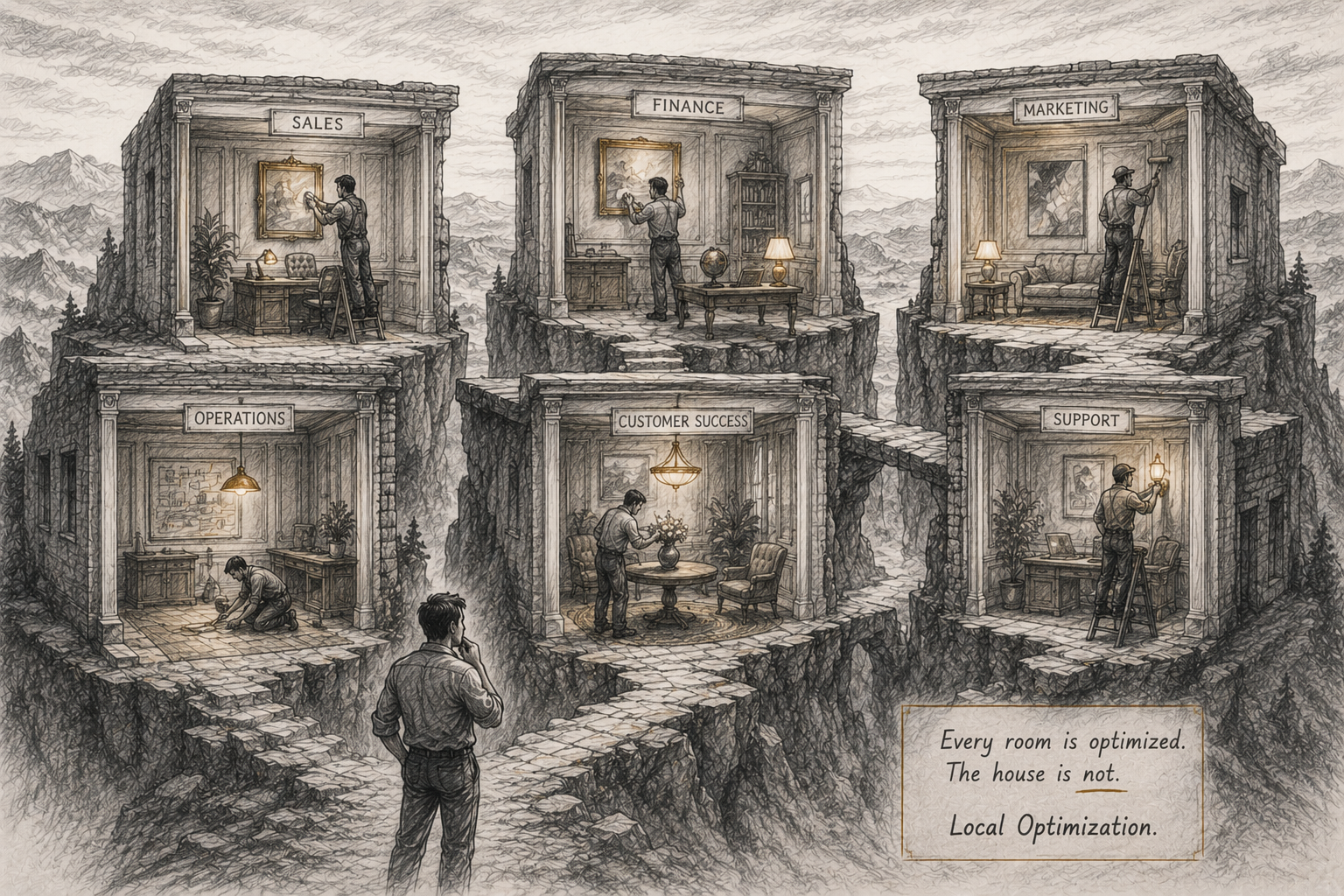
The failure mode no one can diagnose
This failure mode is hard to see because it rarely looks like failure at first.
Roadmaps are full. Teams are busy. Delivery is moving.
But the work that matters most often cuts across the boundaries those teams are organized around.
What this looks like in practice
A company tries to redesign customer onboarding.
Everyone agrees on the goal: make the experience simpler, faster, and easier for the customer.
But the work does not live in one team.
Sales wants fewer handoffs. Implementation wants cleaner intake. Support wants better context. Billing wants complete data. Compliance wants the right controls. Engineering wants stable systems.
Each team is making reasonable decisions from inside its own boundary.
But without someone holding the full picture — how the process, tools, data, controls, ownership boundaries, and seams fit together across all of them — the transformation turns into negotiation between verticals instead of redesigning the capability itself.
The missing role is not just a stronger cross-functional process owner. Most transformations already have business leaders pushing for the outcome. What is often missing is a capability-led architecture role: someone holding the capability shape across process, tools, data, decisions, controls, and execution seams.
The issue is not that the idea lacks value. The issue is that the value is horizontal while ownership, funding, and execution are vertical. No one owns the seam, so the work becomes churn instead of transformation.
The root cause: horizontal value, vertical ownership
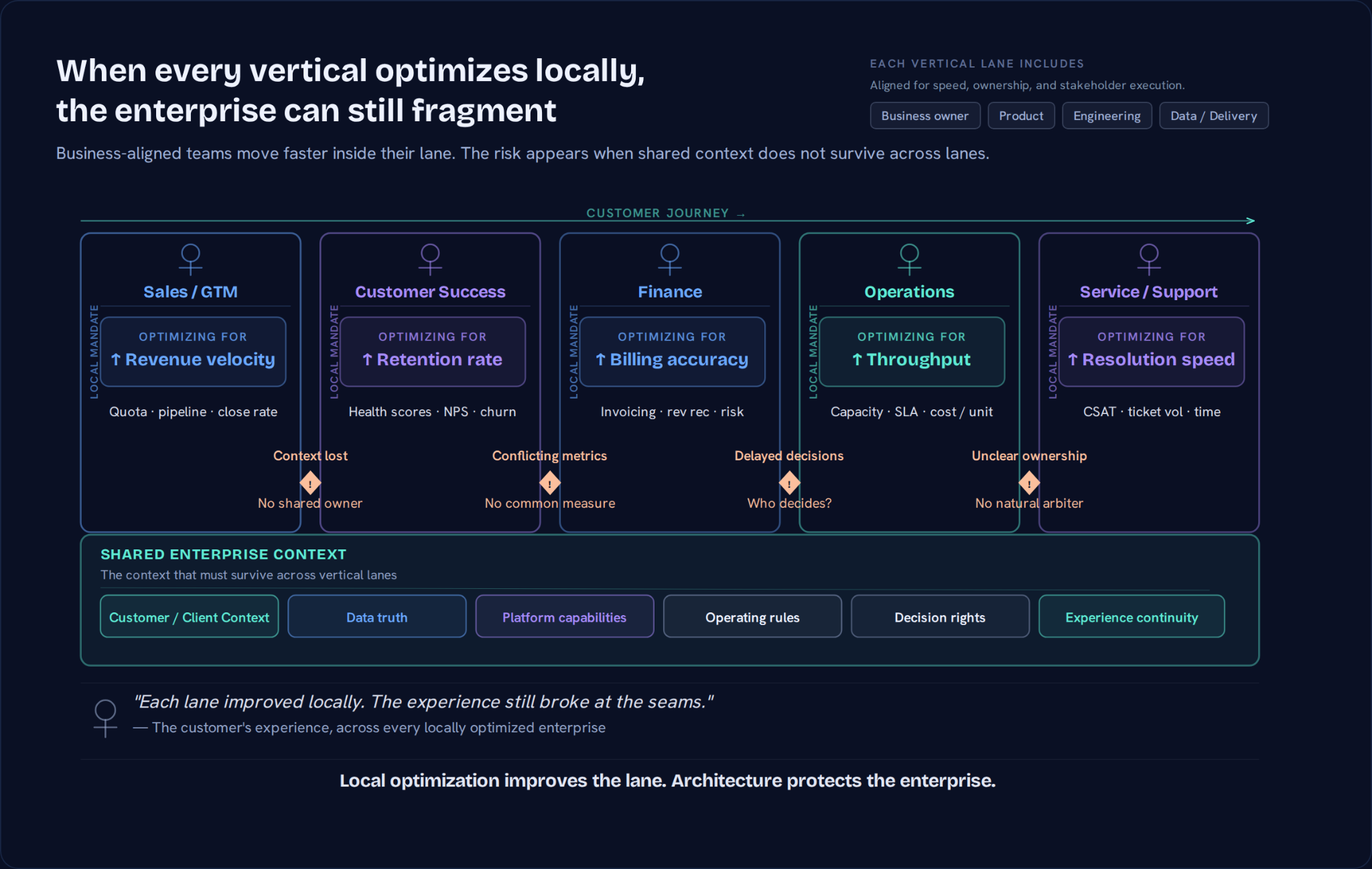
Vertical alignment creates focus and delivery accountability. The blind spot appears when each lane optimizes for a local mandate while shared enterprise context has no natural owner.
The highest-value opportunities often cut across capabilities, processes, data, platforms, customer journeys, and operating models.
They sit between the boxes.
And when something sits between boxes, ownership becomes unclear.
That is where strategic innovation gets constrained.
Not because leaders lack ambition.
Because funding, accountability, and incentives are organized vertically — while the highest-value transformation sits horizontally.
Reaching across the boxes often means taking on risk without clear ownership, funding, or reward.
So transformational ideas wait.
They wait for a C-level mandate. They wait for a structural reset. They wait for a program to be created. They wait for someone with enough authority to force multiple boxes to move together.
But by then, the opportunity has often become more expensive.
Vertical product alignment has real value
It creates focus. It gives business leaders a clear delivery path. It creates accountability between a business area and the product, engineering, and delivery teams supporting it.
That model works well when the goal is to satisfy known demand inside a domain.
Business leaders naturally optimize for their domains. Product teams often mirror those same boundaries. Engineering teams are usually organized the same way.
On the surface, this can look effective: roadmaps are full, delivery is moving, stakeholders have teams aligned to them, and the organization appears responsive.
The problem is not vertical alignment.
The problem begins when vertical alignment becomes the only operating model.
The missing mechanism is capability-led architecture
Capability-led architecture is the horizontal lens
This is where business architecture and enterprise architecture matter — but only when practiced at the right altitude.
Not as documentation functions.
Not as review boards.
Not as architecture scoped to a single platform, stack, or vertical.
The architecture that changes enterprise outcomes is capability-led and cross-domain.
It starts with the capabilities, processes, data, decisions, controls, and outcomes that span the verticals — not with the org chart, the roadmap, or the systems already in place.
That is what allows an enterprise to see above applications, teams, and delivery queues.
It surfaces the value hiding between the seams.
It frames the tradeoffs no single vertical can resolve alone.
And it turns ambiguous cross-domain opportunities into executable transformation roadmaps.
The diagram is the easy part. Increasingly, a tool can draw the boxes and relationships. The harder work is reading across the business, knowing which seams matter, aligning the tradeoffs, and turning that understanding into a roadmap the enterprise can actually execute. That is senior judgment, not a documentation task.
The artifact is not the architecture
A capability map can make the enterprise visible. The value is the judgment that turns that visibility into change.
Why the distinction matters
The distinction is not about titles.
An organization can have people called enterprise architects and still lack a cross-domain architecture practice. Strong technical architecture inside a vertical can solve important problems, but it does not automatically create the horizontal mechanism transformation needs.
Capability-led architecture starts above the vertical. It asks what business capability is changing, what value it serves, what processes and data must move with it, where ownership breaks across domains, and what decisions must remain stable as teams, tools, and systems change.
Business architecture helps the organization see capabilities, value streams, operating models, processes, ownership gaps, and cross-domain business impact.
Enterprise architecture connects that view to data, systems, platforms, integrations, constraints, and execution paths.
Together, they create the mechanism the vertical model does not naturally provide: a way to see across the enterprise before the roadmap hardens inside individual domains.
The answer is not to eliminate vertical product alignment
Vertical product alignment still matters. It creates accountability, focus, and delivery ownership.
The answer is to pair it with a horizontal architecture layer strong enough to see what vertical roadmaps cannot.
Not as documentation.
Not as governance theater.
Not as teams that show up late to approve decisions already made.
As a capability-led mechanism for seeing across seams, framing tradeoffs, and turning ambiguous transformation opportunities into executable roadmaps.
Its job is to make the enterprise shape visible enough that teams can own their parts without losing the whole. It creates context, clarifies boundaries, and lets decisions move inside a shared frame. It does not centralize decisions; it does the opposite.
Because local optimization is not enterprise transformation.
Capability-led, cross-domain architecture creates transformation.
For a case study of this pattern in practice, see GTM Transformation Case Study.