Restarting a Failed GTM Transformation as an IC Architect
How a client-centric GTM transformation got rebuilt from a stalled discovery — and what it took to land it as an individual contributor.
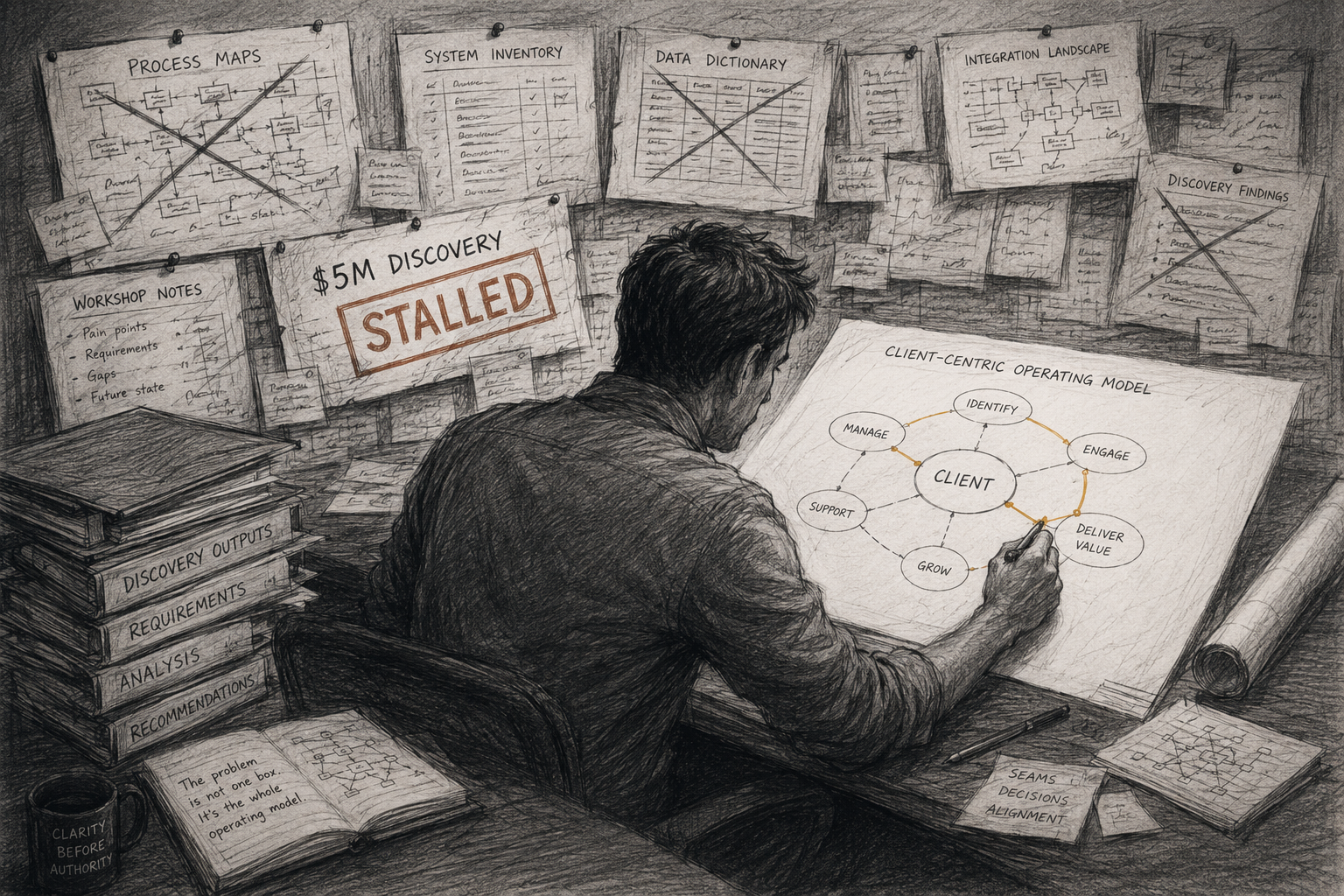
A $5M transformation discovery had stalled. The prior discovery produced artifacts, but not an executable path. This is the story of how that work restarted, how the transformation was reframed, and why it mattered that I did not begin with a title that gave me authority over any of it.
The transformation shape
The work was not approached as a CRM modernization or a platform replacement. It was approached as a capability transformation: how the enterprise identifies clients, manages GTM motion, aligns sales operations, governs data, supports quoting, and creates a foundation for revenue scale.
When the problem does not fit the org chart
The work was owned vertically, but the transformation value lived horizontally — across process, data, systems, and operating-model seams.
This was the real constraint: the work lived horizontally, but the ownership model was vertical.
The starting point
The company had been built with a fast-moving, operational-centric commercial model — organized around how work was processed internally, not around the client. That model had worked at one scale. At the next, it had become a constraint.
The destination was becoming clear: GTM needed to move toward a client-centric model. But the organization had not yet found a way to get there.
The constraint: no formal authority
I had no formal authority over any of this. The work cut across boundaries other people owned, and it came from someone whose formal scope was a fraction of it. The resistance that came with that was not personal — it was structural, the same boundary-defense any cross-domain work runs into.
But it was real, and most senior conversations started at a disadvantage. I had to turn each one around in the first few minutes — not with a mandate, but with the diagnosis.
Authority followed clarity, not the org chart.
The opening: a thin opening became a third shot
The opening was thin. A consultant had been brought in to review prior discovery outputs and repackage them. I asked to be looped in.
Within three weeks, we had run a focused discovery with Sales Operations and built a working proof of concept with a small core team: a consultant, a senior technical program manager who became a trusted delivery partner, and me.
I carried the end-to-end transformation shape — business process, future-state vision, architecture, roadmap, and execution plan — while the three of us worked without rigid boundaries to challenge and validate the model quickly. The consultant and program partner played pivotal roles in the framing phase, helping pressure-test the thinking and convert the vision into something leaders could evaluate.
Later, as Phase 1 moved into delivery, that partner became the day-to-day delivery anchor, leading detailed requirements and execution management with the business analysts, while I continued to own the end-to-end process, application, integration, and architecture direction.
The proof of concept created credibility. But the deeper move was earning enough room to test the real problem.
The diagnosis: the architecture had to be inferred
The architecture had to be inferred
No one owned the full GTM picture, and the inputs were fragmented. There was no documented end-to-end shape to start from. I reconstructed it from data sets, process signals, and capability patterns — with enough confidence to build a transformation on.
What looked like a process problem was not really a process problem.
Technology had been forcing the business to operate a certain way. No one had fixed the foundation, so the business kept building on top of it — each workaround pulling in more enhancements, until the operation was running on accumulated foundational debt.
Over time, process and technology had become so tightly coupled that no one could easily reshape the boundary.
That diagnosis became the hypothesis the transformation ran on: the company did not need more modernization layered on top of the same foundation. It needed to move from an operational-centric model to a client-centric one.
From ambiguity to executable architecture
The company went through major layoffs around this time. In the aftermath, I was given the green light — quietly.
In three or four days I had put together the full value proposition, rollout strategy, roadmap, and cost estimate.
This was not a traditional requirements phase. It operated more like an internal transformation response: define the problem, shape the future state, test feasibility, size the effort, sequence the risk, and make the funding decision concrete.
The work moved from discovery signals to a transformation construct leaders could fund: business architecture, conceptual architecture, product roadmap, resourcing, cost, program plan, and rollout strategy.
I chose against a big-bang rollout. Instead I designed a phased approach and deliberately kicked off Phase 2 before Phase 1 closed, so the phases de-risked each other rather than stacking risk. Funding was approved almost immediately because the impact case was clear and the execution path was concrete.
I do not just analyze complexity. I compress it into an executable decision.
Detailed subsystem knowledge was incomplete at the beginning. That was where capability abstraction mattered. Instead of waiting for every application and integration detail to be documented, I abstracted the transformation into capabilities, seams, building blocks, dependencies, and risk areas — enough structure to move without the full picture.
The abstraction became the contract the teams executed against.
In parallel, I shaped the target-state enterprise architecture, the CRM dual-run strategy, the migration approach, and the preliminary Phase 2 architecture.
Built across altitudes at once
The work was not one layer of architecture at a time. I built and held the model across business, enterprise, solution, and execution layers simultaneously.
The execution model: context, not control
The start carried real concentration risk, and I handled it by pushing ownership out, not holding tighter.
I did not scale by doing more. I scaled by giving every team enough context to own their part — and connecting the whole myself.
Most programs hand a team a feature and move on. I did the opposite. I walked domain architects and leads through the whole business process repeatedly — not just their slice — so they could design their part as part of the whole.
Then I cut unnecessary review layers and got out of the way. Teams owned their boundaries. Teams had freedom to design. Teams had room to fail fast and adjust. That — not me being in every room — is what made decisions faster.
I stayed the connective thread across the business, information, application, and integration architectures. I stepped in directly where the risk was highest: system-wide provisioning design that touched nearly every process in the platform, stalled workstreams that needed recovery, and data migration when it moved to the edge.
The hardest part was not the technical design alone. It was the conviction.
I could see across the silos what each team, optimizing inside its own, could not. I had to challenge inherited assumptions about tools, processes, and boundaries, and trust the cross-cutting view enough to push the organization forward.
Business teams were not always comfortable with the scale of change. Technical teams were often anchored in current-state constraints. Holding the future-state shape visible while the organization moved through that discomfort was the work.
Crisis one: the agency data nobody owned
To enable relationship and book management at scale, I shipped a critical capability outside the CRM — essential for business continuity, and not something the CRM was going to do well.
Data migration had started but lacked strategic data skills and clear ownership. Once development stabilized, I pivoted and took the data transformation myself so commissions and sales workflows would not break at cutover.
Then I hit the agency data. It had no owner, and a relationship-centric model is impossible without it. The business wanted to skip it. I refused. The only available path was to reconstruct the truth from fragmented sources, align the stakeholders, and resolve the data before go-live.
That was not grunt work and it was not heroics. It was the only available way to figure out what the truth actually was before go-live. Reverse-engineering process truth from data lineage is the thing I have been doing for 25+ years. This is where it paid for the whole program.
Data truth became business truth
The agency problem was not just dirty data. It was an ownership seam the operating model had never resolved.
Crisis two: the Phase 2 migration recovery
Phase 2 migration was a large multi-team effort that had stalled. Confidence was collapsing. Multiple leaders had visibility, but the recovery still lacked a clear execution shape.
The original migration logic assumed a cleaner system than the one we actually had.
I volunteered to spend two weeks helping. I came in with a redesigned migration strategy I believed was doable with the right mindset. Within a week the situation had clarified enough for the work to be reset around a different approach.
We rebuilt the core migration and reconciliation logic, rolled out in phases, and went live on the original date with no business disruption.
The stalled migration could not be rescued by more status meetings. It needed a different execution shape: strategy, reconciliation, recovery logic, phased rollout, and protected go-live.
Recovery required redesigning the path, not pushing harder
The stalled migration could not be rescued by more status meetings. It needed a different execution shape.
Outcomes and what the case proves
- Helped establish a client-centric GTM foundation tied to significant annual revenue opportunity.
- The company moved from an operational-centric to a client-centric commercial architecture — the destination prior attempts had failed to reach.
- Critical data and migration risks were resolved without slipping the date or disrupting commissions, sales workflows, or the business.
- Domain teams were empowered to own decisions inside clear boundaries while the end-to-end architecture stayed connected.
- Promoted to Technical Fellow during the program and rated "Transformational" for two consecutive cycles.
I did not have a title that gave me power. Every senior conversation started at a disadvantage, and I had to convert doubt into trust in real time — through diagnosis, clarity, and delivery, not authority.
Authority earned in real time turned out to be more durable than the kind that comes with a title.
The reason an IC was trusted with this scope is rare and worth naming: it required a leader willing to look past the org chart and bet on how someone thinks before the track record made it safe. That kind of bet is what makes IC-led transformation possible at all.
Most transformations of this kind do not get an architect who can operate across every altitude at once. This one did, because someone chose to make the room for it.
What the case proves
The story is not about heroics. It is about what becomes possible when one architecture thread connects business truth, system truth, data truth, and delivery truth.
The same pattern shows up now in AI-native product work — different surface, same connective role.
The six levers behind this transformation are captured in the companion playbook: The IC Architect’s Transformation Playbook.