The Transformation Architect's Vantage
Every function sees a valid part of the transformation. The architect holds how those parts change the whole.
Every transformation begins with several versions of what is right.
The business sees urgency — a need that may already have waited too long. Product sees customer value and the capabilities required to create it. Engineering sees feasibility, structural constraints, and the risk hidden beneath what looks like a straightforward request. Delivery sees commitments already in motion and the consequences of disturbing them. Operations sees how much change the organization can realistically carry.
Each perspective is grounded in real accountability. None of them has to be wrong for the transformation to lose coherence.
The problem is not that the functions see too little. The problem is that no single function is responsible for what all their decisions produce together.
That is where the transformation architect's responsibility begins.
Architectural vantage is not seeing more than everyone else. It is seeing how each partial truth changes the whole.
Vantage is not authority
It would be easy to interpret architectural vantage as a claim that the architect sits above the functions, holds the most complete knowledge, or should have the final word. The concept collapses the moment it is understood that way.
The architect usually does not own the teams, make most of the decisions, or control the program. Product understands the customer and product landscape more deeply. Engineering understands the systems and implementation constraints more directly. The business understands its own operations, pressures, and opportunities in ways the architect cannot reproduce from a distance.
Those perspectives are not fragments because the people holding them lack judgment. They are partial because every role is accountable for a different part of the enterprise.
That partiality is often what makes the perspective useful. Accountability creates focus. Proximity develops expertise. Product is accountable for customer and business value, so it sees the capabilities needed to create it. Delivery is accountable for commitments, so it sees schedule risk. Operations must live with the change after the program moves on, so it sees adoption.
The architect does not replace those perspectives or rank them from above. What the architect holds is the relationship among them — and between the decisions being made now and the destination the organization is trying to reach.
That is vantage: not a higher seat, but a different responsibility.
Following the decision beyond where it was made
Organizations create accountability by dividing responsibility. Transformation moves differently.
A decision may begin inside a product team but alter an operating process owned elsewhere. A practical engineering choice may establish assumptions that later constrain the business. A sequencing decision may protect the current release while making the next one harder. A local solution may shift complexity into another domain that was not represented when the decision was made.
The consequences travel horizontally even when accountability remains vertical.
The transformation architect follows the decision beyond the boundary in which it first appeared.
Across the organization, that means tracing how a change in one domain alters the assumptions, responsibilities, data, and processes of another. No single team is designed to see every consequence moving through those seams, because no single team owns all of them.
The architect also moves between levels of abstraction. Business intent becomes an operating model. The operating model becomes capabilities. Capabilities become processes, products, services, data, integrations, and controls. Those eventually become implementation decisions.
Each level can appear coherent on its own while drifting away from the others. A technology team may implement a request exactly as described while reinforcing the wrong operating model. A target architecture may look elegant while depending on business ownership that does not exist. A strategy may sound compelling while assuming capabilities the organization has no credible path to build or absorb.
The architect keeps asking whether the business intent, the capability model, the architecture, and the implementation still describe the same transformation.
Then there is time. Transformation architecture is not only about how the future should work when complete. It is about what today's choices make possible tomorrow. Some decisions preserve options. Others quietly close them. Some create an intentionally temporary bridge; others become permanent because every later decision inherits them. A foundation that looks premature today may become prohibitively expensive to introduce after processes, integrations, and data have accumulated around the old model.
That movement — across organizational boundaries, between levels of abstraction, and through time — is what creates the architect's vantage. The transformation boundary may be one visible output of that vantage, but it is not the vantage itself.
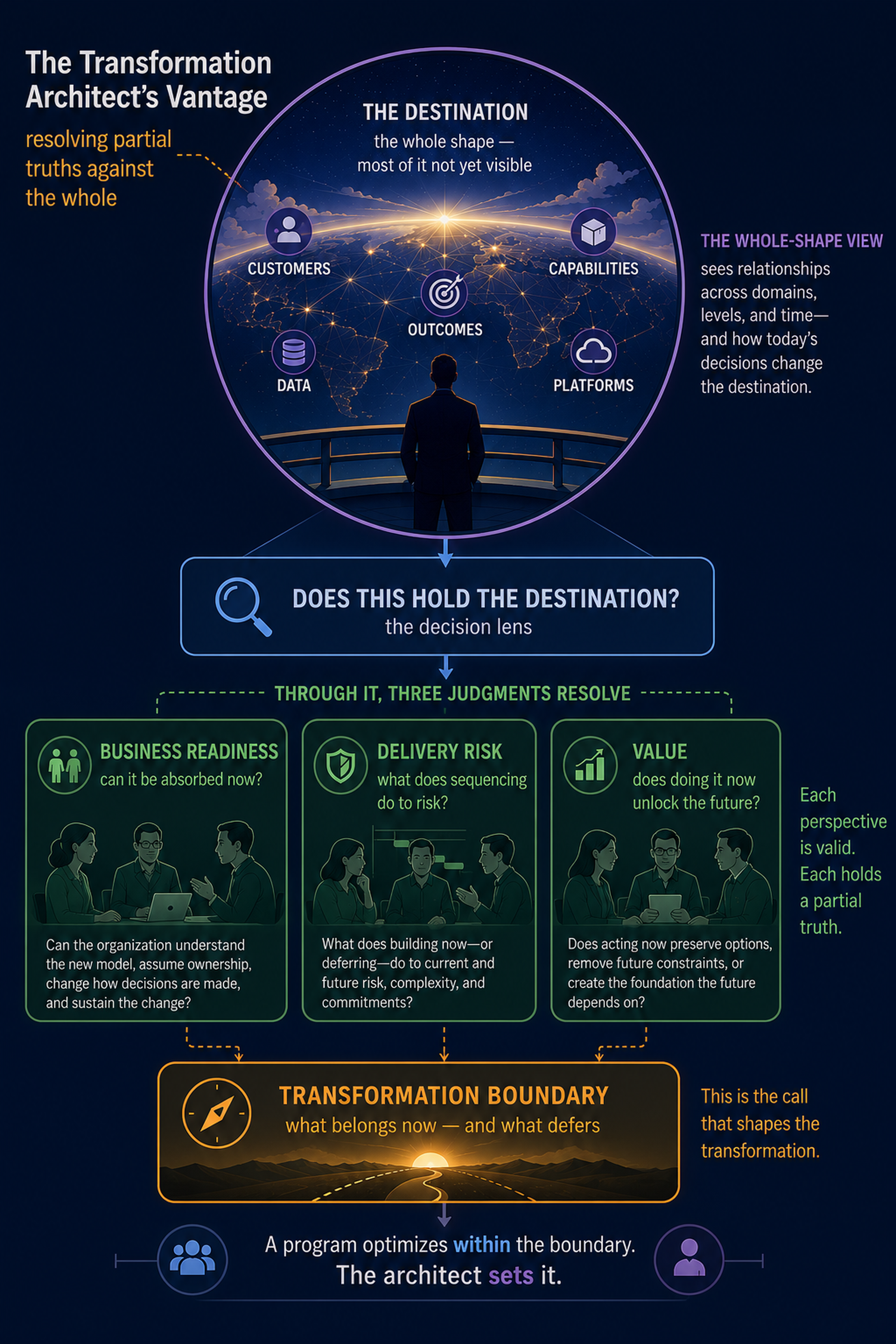
The lens: does this hold the destination?
Transformation rarely begins with a fully visible destination.
The organization may understand the problem without yet understanding the complete future operating model. The required capabilities may be directionally clear while ownership remains unsettled. The architecture may need to preserve several possible paths until the business learns enough to commit to one.
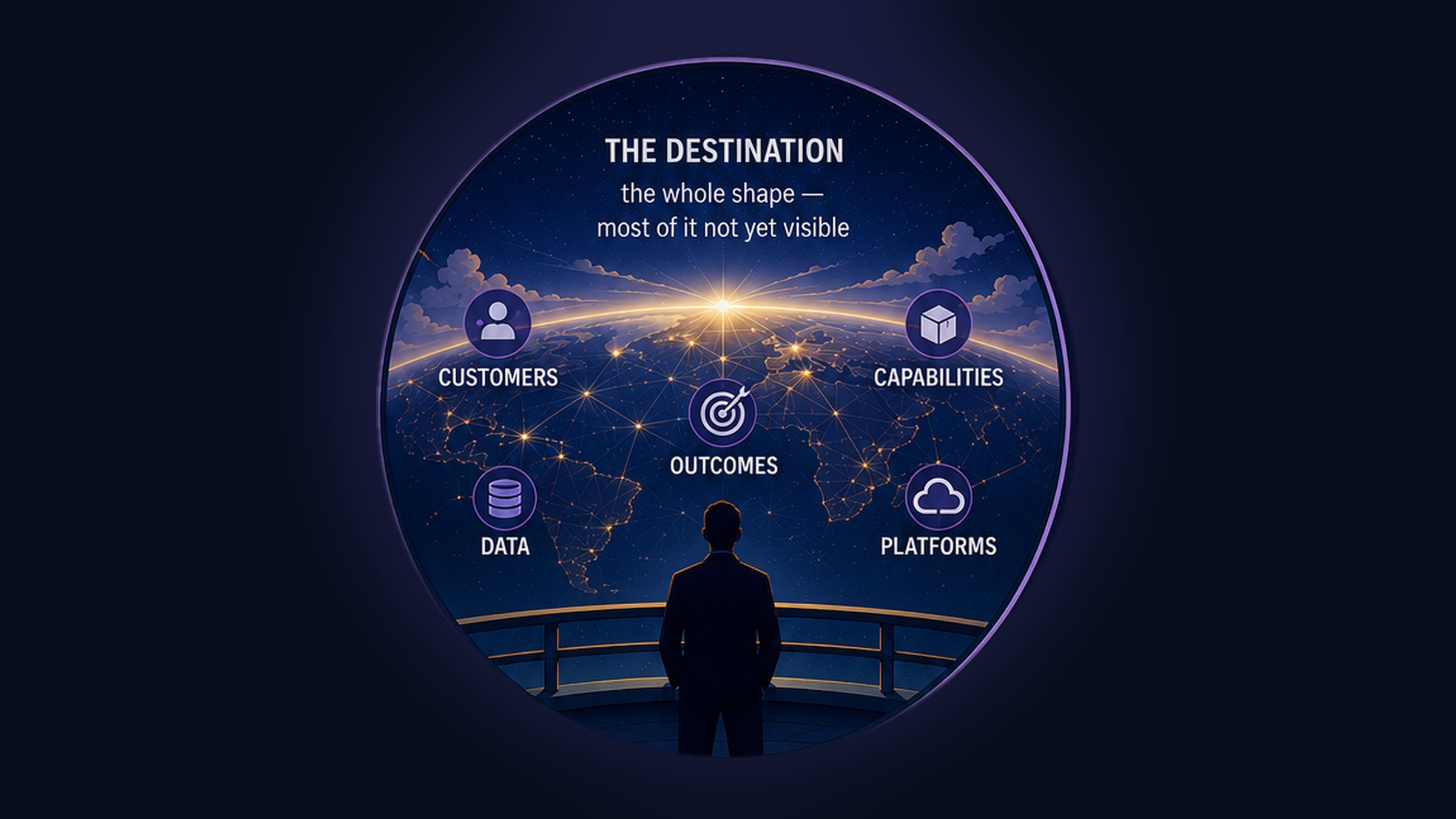
The destination is therefore not a perfect end-state blueprint waiting to be implemented. It is the whole shape the transformation is trying to produce: the business model, customer experience, operating processes, decision rights, capabilities, systems, data, governance, and the path by which the organization can move from where it is to where it needs to be.
Much of that destination may not yet be visible. The architect still needs a lens through which present decisions can be evaluated:
Does this hold the destination?
That question does not ask whether every decision matches an ideal future-state design. Transformation cannot wait for perfect certainty, and the full future cannot be forced into the present. The question is more practical.
Does the decision preserve the direction, or quietly bend it? Does it leave future options open, or close them before the organization has consciously chosen? Does it create a reversible step, or an irreversible commitment? Does it strengthen coherence across domains, or solve one local problem by transferring the cost elsewhere? Does it let the organization learn before making the next bet? Does it make the next movement easier — or leave the transformation carrying a constraint it may never have the time or funding to remove?
The destination gives today's compromises meaning. A compromise made in service of a known direction can be intentional. The same compromise, made without that direction, can become accidental architecture.
Three judgments, resolved together
Three judgments pass through the destination lens. They are not independent gates, and they do not form a checklist. Each requires judgment grounded in evidence, and they frequently point in different directions.
Business readiness asks whether the organization can absorb the change now. This is not simply a question of training or communication. It is an assessment of whether the business can understand the new model, assume the required ownership, change how decisions are made, and sustain the process after the program moves on. A capability can be technically complete and still fail as a transformation — people may use the system while continuing to think through the old model, teams may route around the new process, ownership may remain unclear. The technology moves, but the organization does not. Readiness is therefore not an activity that follows architecture. It is one of the conditions the architecture must account for.
Delivery risk asks what sequencing does to risk. The question is not limited to whether something can be delivered on time. Deferring a structural decision may simplify the current phase while making a later migration significantly harder. Advancing a foundation too early may increase complexity before its value can be demonstrated. A tactical bridge may reduce risk when it is intentionally reversible, but become dangerous when it quietly establishes the permanent architecture. Sometimes the safest decision for the current release creates the greatest risk for the transformation.
Value asks whether doing it now unlocks the future. This is not ordinary cost-versus-benefit. Some work creates value because the business can use it immediately. Other work earns its place because delaying it would close an important option, create an expensive detour, or establish a structural constraint that becomes difficult to remove later. A foundation may need to exist before the business is ready to use everything it enables. This does not license using hypothetical futures to justify building everything early; the judgment is whether acting now materially preserves or unlocks the destination.
The tension among these judgments is where vantage becomes most visible. Readiness may say not yet. Value may say the foundation cannot safely wait. Delivery risk may reveal what pulling it forward would do to every other commitment.
Three separate answers do not produce a coherent decision. The architect's contribution is resolving their interaction.
When building and absorbing separate
When readiness and architectural value conflict, the instinct is often to assume one must override the other — either the organization is forced to adopt a change it cannot yet carry, or the whole capability is deferred and the future risk is accepted.
But what must be built now and what must be absorbed now are not always the same thing.
The business may not be ready to adopt the complete future process. The architectural foundation beneath it may still need to be established, because waiting would close options, create a costly migration, or force future work onto assumptions that no longer fit. In that case, the boundary can separate the two movements. The enabling foundation is established now; the operating change the organization cannot yet absorb is deferred.
Readiness has not been dismissed. Architectural value has not been ignored. Each has changed where the boundary is drawn.
That is one important resolution pattern, but it is not the only one. Sometimes the right move is to preserve an interface or option without building the full foundation behind it. Sometimes capability and adoption should advance together. Sometimes both should wait, because deferral does not materially weaken the destination.
The architect is not applying a fixed rule. The architect is determining what must belong now, what can safely wait, and what must remain possible.
Business Readiness
Can it be absorbed now?
Present capacity to understand, own, operate, and sustain the change.Delivery Risk
What does sequencing do to risk?
Consequences of building now or deferring across risk, complexity, and commitments.Value
Does doing it now unlock the future?
Preserves options, removes future constraints, or creates a foundation the future needs.The boundary is an output, not the point
Resolving those judgments produces a transformation boundary: a line between what belongs in the transformation now, what should defer, and what must remain possible later.
That boundary is the visible artifact of vantage, but it is not its definition. It is easy to mistake the line for the whole job, just as it is easy to mistake a diagnosis for the reasoning that produced it. The boundary is only as coherent as the understanding behind it.
It is also more than ordinary program scope. Scope describes what a program has committed to deliver. The transformation boundary explains why that scope forms a coherent movement toward the destination. It protects the present from being overwhelmed by a future the organization cannot yet absorb, and it protects the future from being quietly constrained by decisions made only to simplify the present.
Within that boundary, a program can optimize — sequencing work, managing dependencies, allocating capacity, negotiating milestones, choosing practical implementation paths. But those optimizations are only as coherent as the boundary around them.
"Sets it" does not mean the architect possesses unilateral authority. Formal approval may belong to business, product, engineering, finance, or executive leadership; the architect may not own the budget, the teams, or the plan. But someone must hold the whole-shape reasoning from which a coherent boundary can be approved. Someone must be able to explain what each option enables, what it constrains, what risk it transfers, what it asks the organization to absorb now, and what future it quietly closes.
The architect's contribution is not the authority to impose the line. It is the responsibility to make the line coherent, legible, and defensible — so that those who hold the authority can approve a decision that still holds the destination.
Authority determines which path the organization will take. Architectural vantage makes visible where each path leads.
What the vantage actually is
Over time, I found the simplest language for that responsibility:
I was not representing a function. I was protecting the transformation.
That did not mean the functions were wrong, or that my perspective mattered more than theirs. It meant my responsibility was different. Product could keep protecting product value. Engineering could protect feasibility and structural integrity. Delivery could protect commitments. The business could protect urgency and operational need. The architect had to protect whether those perspectives, taken together, still produced the intended whole.
That responsibility does not require owning every team, making every decision, becoming the program manager, or standing above the people closest to the work. It requires following decisions beyond the boundaries where they are made, and remaining accountable for coherence when ownership is distributed.
That coherence is often easiest to see after it has been lost. Every team delivers, but the business does not transform. A capability goes live, but the organization keeps operating through the old model. One domain solves its problem by creating another domain's constraint. A tactical decision becomes permanent because no one preserved the path beyond it. The program meets its commitments, but the destination moves further away.
The transformation architect's work is to make those consequences visible before they harden into the system. The architect does not replace functional judgment or force the ideal future into the present. The responsibility is to keep several valid partial truths from producing an incoherent whole.
That is the architect's vantage: not a higher seat in the hierarchy, but the responsibility to hold what no single function is designed to see alone.